
What is the Typical Spread Between Max and Flash Grade?
 PK
PKPeter Klimek
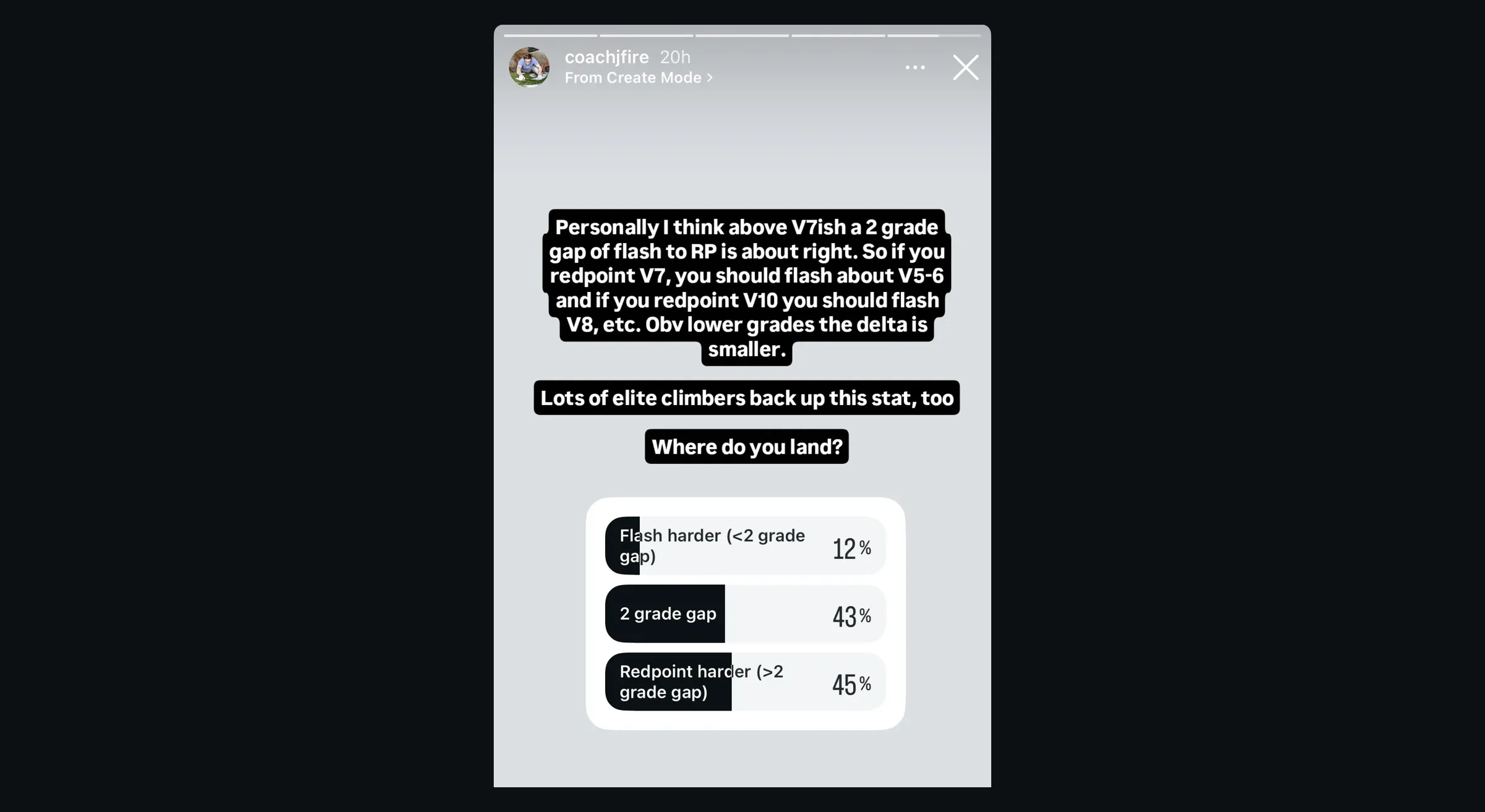
Coach Jesse Firestone (@coachjfire) posed this question to his Instagram audience:
How many V-grades should separate your flash grade from your redpoint grade?
He suggested that above V7, a 2-grade gap is about right — V7 climbers should flash V5-6, V10 climbers should flash V8. Most respondents reported a gap of 2 grades or more.
We love this question because we use flash grade as a basis for helping climbers calibrate the appropriate difficulty levels of their training sessions. It's also very timely given Adam Ondra's historic flashing spree — 3x 8C/ V15 ⚡ Flash in 2 weeks. So we figured this was a good opportunity to look into the data a little bit more.
An Important Note
Max grade is fairly consistently defined as the hardest grade you've ever sent (i.e. a personal best). But there is a bit of nuance we need to introduce before talking about your flash grade since not everyone refers to it in the same way.
The background
A few years ago, Alexei Drummond and Alex Popinga published a paper that formalized the concepts of flash grade and session grade using Bayesian inference on ascent data from theCrag. Their definitions are straightforward: your flash grade is the grade you have a 50% chance of sending on your first try. Your session grade is the grade you have a 50% chance of sending within a session. There's plenty of nuance around style, rock type, conditions, etc. when talking about flash grade — but put that aside for now.
We added these definitions to Crimpd in 2023 and use them to help climbers tune the intended difficulty of their climbing sessions. But not everyone refers to flash grade this way. So for the purposes of this blog post, just remember that "Flash Grade" = "the grade you can typically flash" — not your hardest flash ever.
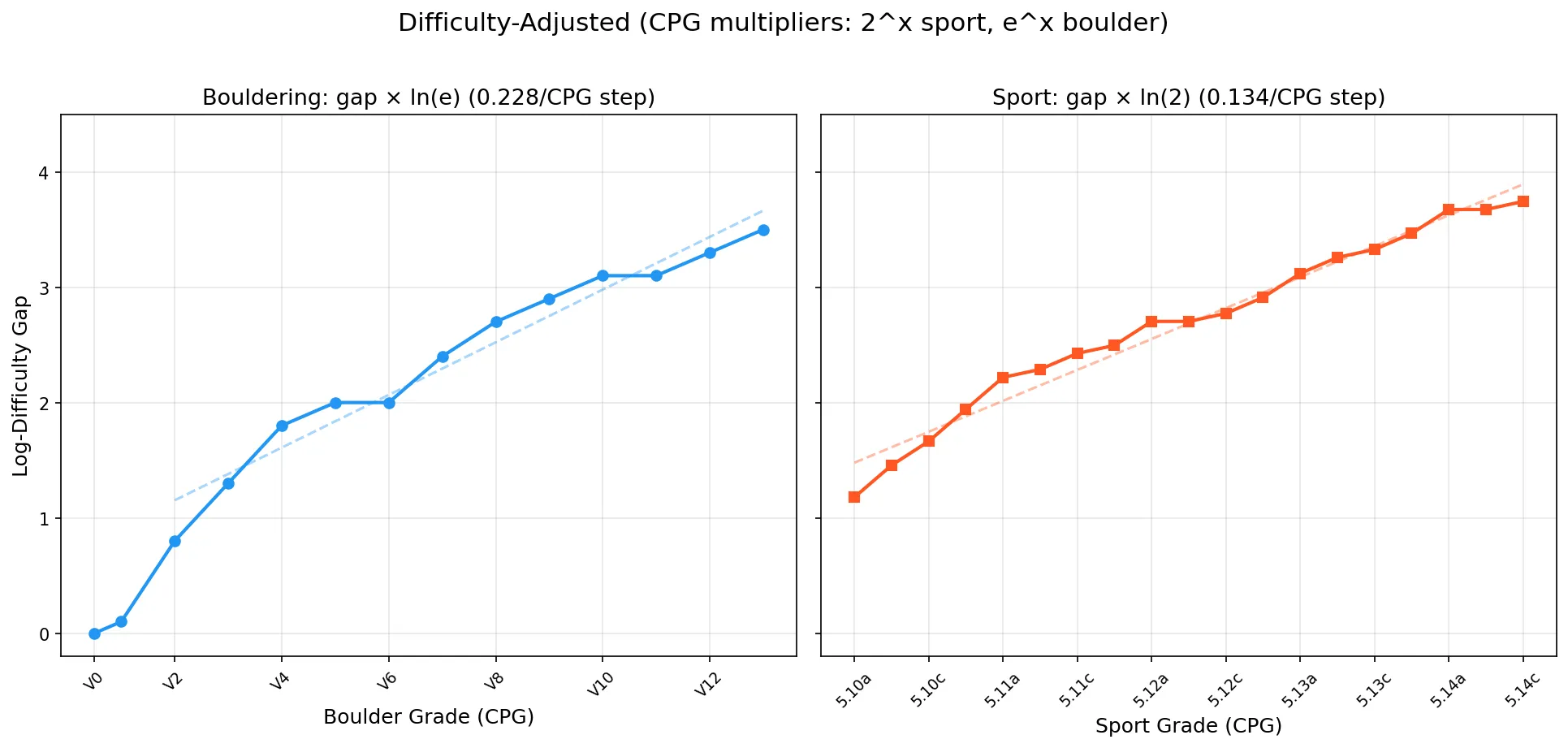
One of the more useful findings from the same paper: each V-grade step represents roughly 3x more failed attempts than the previous grade. In sport climbing, each grade step is about 2x. In plain terms, each V-grade is a bigger jump in real difficulty than each sport grade. This turns out to matter a lot when comparing flash-to-max gaps across disciplines.
Now let's see what the data shows.
The data
After data prep, we have ~90k boulderers in the Crimpd database who've set all three grade levels — max, session, and flash. Here's the average gap between max and flash at every V-grade.
| Max Grade | Users | Avg Gap | Typically Flash |
|---|---|---|---|
| V2 | 4,805 | 0.8 | V1 |
| V3 | 10,254 | 1.3 | V2 |
| V4 | 16,179 | 1.8 | V2 |
| V5 | 20,231 | 2.0 | V3 |
| V6 | 17,358 | 2.0 | V4 |
| V7 | 8,511 | 2.4 | V4+/V5 |
| V8 | 5,784 | 2.7 | V5/+ |
| V9 | 3,589 | 2.9 | V6 |
| V10 | 1,067 | 3.1 | V7 |
| V11 | 496 | 3.1 | V8 |
| V12+ | 262 | 3.4 | V8+/V9 |
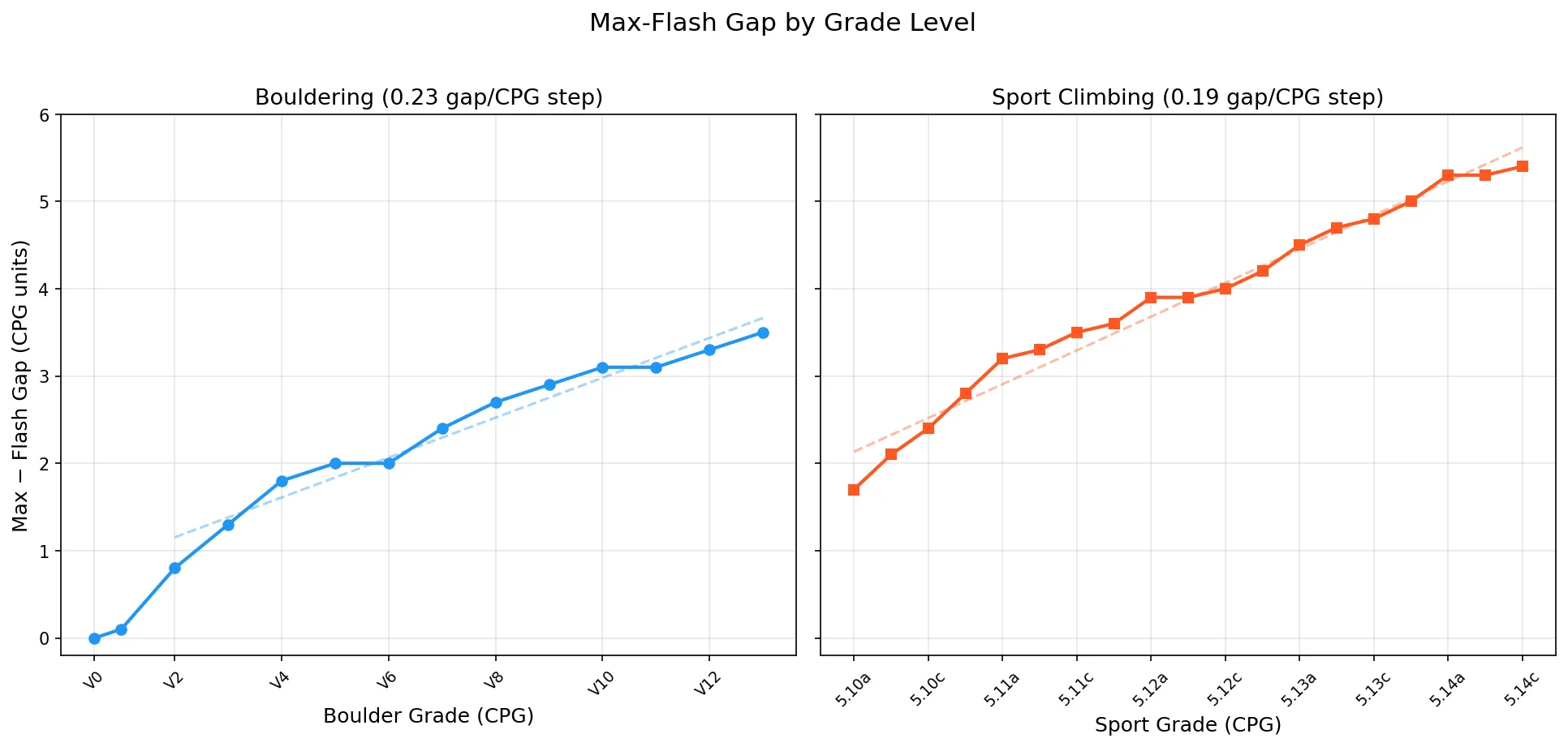
At lower grades, V2-3 climbers have only about a 1-grade gap between their max and flash, but the spread grows steadily from there. Our data shows V7 climbers flash at V5 on average, with a gap of 2.4 grades. V10 climbers flash at V7 on average — a gap of 3.1 grades.
The key finding: the gap keeps growing above V7. By V9 it's nearly 3 grades. By V10+ it's 3.1. By V12+ it's 3.4. The 2-grade rule works as a starting point, but it underestimates the spread for stronger climbers when using the 50% flash definition.
What about sport climbing?
Here's the same breakdown for ~95k sport climbers:
| Max Grade | Users | Avg Gap | Typically Flash |
|---|---|---|---|
| 5.10a | 4,486 | 1.7 | 5.8 |
| 5.10b | 6,540 | 2.1 | 5.9 |
| 5.10c | 4,335 | 2.4 | 5.10a |
| 5.10d | 7,182 | 2.8 | 5.10a |
| 5.11a | 7,712 | 3.2 | 5.10b |
| 5.11b | 8,185 | 3.3 | 5.10c |
| 5.11c | 5,404 | 3.5 | 5.10d |
| 5.11d | 7,040 | 3.6 | 5.10d |
| 5.12a | 5,672 | 3.9 | 5.11a |
| 5.12b | 3,680 | 3.9 | 5.11b |
| 5.12c | 2,194 | 4.0 | 5.11c |
| 5.12d | 1,918 | 4.2 | 5.11d |
| 5.13a | 1,439 | 4.5 | 5.11d |
| 5.13b | 1,159 | 4.7 | 5.12a |
| 5.13c | 519 | 4.8 | 5.12b |
| 5.13d | 327 | 5.0 | 5.12c |
| 5.14a | 179 | 5.3 | 5.12d |
| 5.14b | 90 | 5.3 | 5.13a |
| 5.14c | 36 | 5.4 | 5.13b |
The same pattern holds — a 5.12a climber typically flashes 5.11a, nearly a full number grade below. By 5.14a+ the gap stretches to over 5 letter grades.
How do they compare?
Sport climbers show wider spreads on paper — a 2.47-grade gap on average, compared to 1.77 for boulderers.
But that's misleading. Each V-grade is a bigger jump in real difficulty than each sport grade (~3x vs ~2x), so you simply need more sport grades to cover the same ground. When we correct for this using the difficulty slopes identified by Drummond & Popinga, the gap essentially disappears.
Key takeaways
- The 2-grade rule is a decent starting point, but it's closer to a floor than a ceiling once you're above V7.
- The gap keeps growing. V10+ climbers should expect a 3-grade gap, not 2. This is a natural consequence of advancing in difficulty — harder boulders demand more preparation. But as Adam Ondra shows, and Jesse frequently talks about, flashing is a skill that you can train.
- Sport spreads look wider in grade steps, but that's mostly the scale talking. After adjusting for the different difficulty curves, the true gap is nearly identical across disciplines.
We'll do some follow-up posts in the future to talk a bit more about flash and session grades and why we use them.
-pk
About the author
PKPeter Klimek
Co-founder & Developer
Peter is the co-founder of Crimpd and the CTO of Lattice Training. He builds training tools for climbers who want to get stronger without guesswork. When he's not working, he can be found building trails and developing new boulders in the Pacific Northwest.